


Confidence Is Built by Doing
Four sources of confidence
Albert Bandura identified four mechanisms through which self-efficacy is built. They are not equal. The first is by far the strongest.
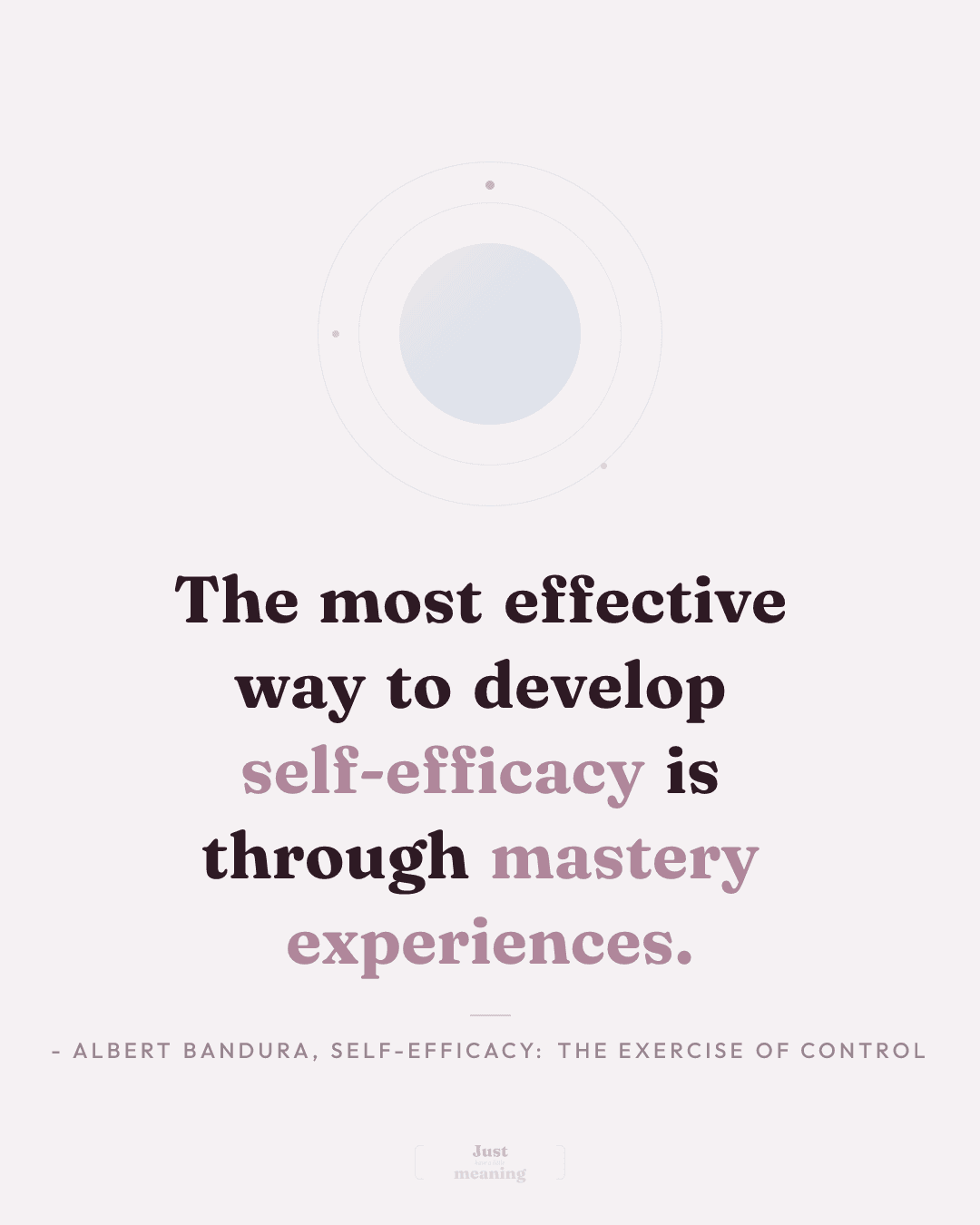
First and most important: mastery experiences. You do something difficult and come out the other side intact. Not because it was easy. Precisely because it was hard, and you did it anyway. Each such experience shifts your internal self-image. It leaves a mark: "I handled it." Confidence in a specific domain is built from those marks.
Second: observing others. When you see someone similar to you handling something that frightens you, your belief that "maybe I can too" grows. This is why mentoring works. This is why stories of people who started from the same place as you carry a force that abstract advice does not.
Third: what you hear from others. When someone you respect tells you "I can see you are handling this well," it strengthens confidence. But only when it is specific and sincere. A generic "you've got this" with no basis builds nothing.
Fourth: the state of your body. When you are rested, nourished, and recovered, you interpret tension before a hard task differently than when you are exhausted. In the same physiological state you can read arousal as excitement or as dread. Physical condition affects how you read your own emotions.
Why confidence is not universal
Confidence is not one trait that you either have or do not. It is tied to specific domains. You can feel competent at work and completely helpless in a new social situation. You can drive a car with ease and panic before a public speech.
This distinction matters because it means you cannot build confidence "in general." Affirmations in the mirror do not work not because you are too weak. They do not work because confidence is built through experience in a specific domain, not through a general belief in your own worth.
If you lack confidence in relationships, professional achievements will not build it. You need experience in relationships. If you lack confidence in public speaking, being a strong writer will not help. You need to speak.
How interpretation changes everything
Carol Dweck, a psychologist at Stanford, adds another element. Two people can go through exactly the same experience and draw opposite conclusions.
If you treat failure as proof that you are "not cut out for it," the experience destroys confidence instead of building it. If you treat it as information that you need to try differently, the same experience strengthens it.
Confidence is not built by successes alone. It is built by how you interpret both successes and failures. A person who thinks "now I know what to improve" after a failed presentation walks away stronger. A person who thinks "I knew I shouldn't have done that" walks away weaker. Same event, two opposite effects.
Further reading
- •Self-Efficacy: The Exercise of Control — Albert Bandura
- •12 Rules for Life — Jordan B. Peterson
- •Mindset: The New Psychology of Success — Carol Dweck