


Negotiate With Yourself
The science behind psychological reactance
Psychological reactance was first described by social psychologist Jack Brehm in 1966. His core finding was straightforward: when people perceive that their freedom to choose or act is being threatened or eliminated, they experience a motivational state that drives them to restore that freedom, often by doing the opposite of what they were told.
What Brehm observed in interpersonal situations applies just as powerfully inside your own head. When you issue yourself rigid commands, "I must work out every day," "I cannot eat sugar," "I have to stop procrastinating," you are not just setting a goal. You are also framing your future self as a subject who can be controlled by threat. And that framing reliably produces the same push-back that external coercion does.
Research published in the decades following Brehm's original work has extended the concept to self-regulation. When people adopt a highly restrictive, rule-based approach to changing their behavior, they tend to show what researchers call "ironic rebound," the forbidden thought or behavior becomes more salient, not less. This is why diets built on absolute prohibition so often end in binges, and why rigid productivity systems so often collapse into avoidance.
The mechanism is not moral weakness. It is a basic feature of how human motivation works.
Self-discipline vs. self-tyranny
There is a meaningful difference between self-discipline and self-tyranny, and the difference is not about how strict you are. It is about the relationship you have with yourself in the process.
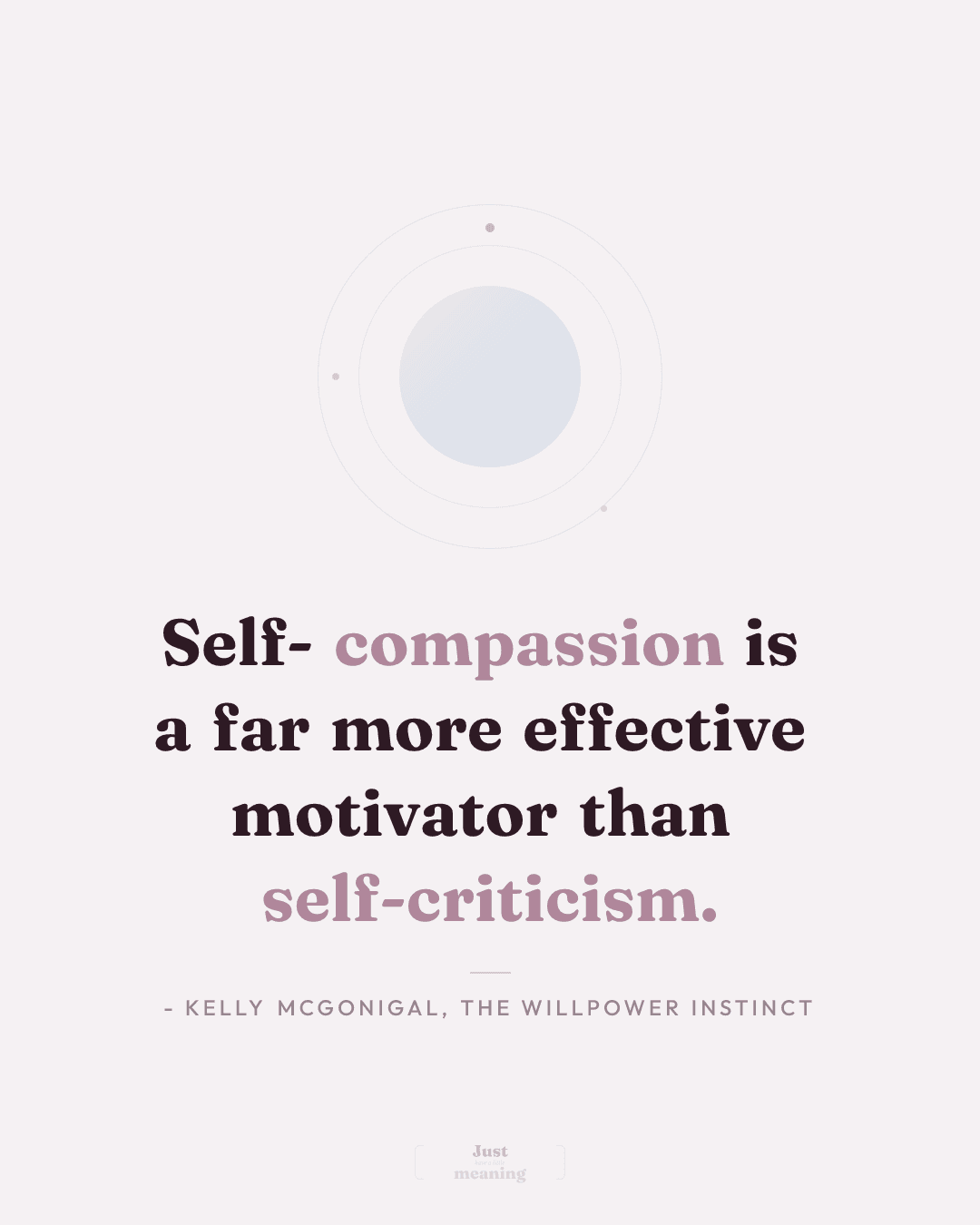
Self-discipline, in the psychological sense, is the capacity to act in line with your values and long-term goals even when it is uncomfortable in the short term. It is compatible with flexibility, self-compassion, and acknowledging difficulty. Research by Kristin Neff and colleagues on self-compassion, the capacity to treat yourself with the same understanding you would extend to a good friend, consistently shows that self-compassion supports rather than undermines motivation and performance. People higher in self-compassion are more willing to acknowledge their failures honestly (because they are less afraid of the self-attack that might follow) and more likely to try again after setbacks.
Self-tyranny looks different. It is characterized by harsh internal commands, all-or-nothing thinking, and treating any shortfall as evidence of fundamental inadequacy. The short-term effect can look like motivation, the anxious energy of someone trying to avoid punishment. The long-term effects, documented in research on perfectionism and self-criticism, include higher rates of procrastination, burnout, and ultimately lower achievement than people with more self-compassionate orientations.
Procrastination, in this light, is not a productivity problem. It is frequently a protection response, your psyche avoiding the harsh judgment it has learned to expect when things do not go perfectly. The avoidance relieves short-term anxiety even as it creates long-term costs. Understanding this mechanism is the first step toward changing it without simply adding more self-criticism to the pile.
How to negotiate with yourself in practice
Negotiation, in interpersonal contexts, works because it replaces zero-sum coercion with a process that acknowledges both parties have legitimate interests. The same structure applies internally.
A few strategies that have empirical support:
**Set fair expectations, then adjust them.** Rather than committing to a fixed standard and treating any deviation as failure, treat your initial commitment as a starting position. If you aimed to write for 45 minutes and managed 20, the useful question is not "why did I fail?" but "what would make 20 minutes sustainable as a baseline?" Research on implementation intentions (Gollwitzer, 1999) shows that specifying when, where, and how you will act significantly increases follow-through, but the same research suggests that overly ambitious plans without contingency thinking are fragile.
**Reward progress, not just outcomes.** Behavioral research consistently supports the role of reinforcement in sustaining behavior over time. This does not mean elaborate reward systems. It means noticing and acknowledging when you did something difficult, even partially. Kelly McGonigal's work on willpower, drawing on the broader self-regulation literature, emphasizes that small acknowledgments of effort help sustain motivation across time in ways that outcome-only focus does not.
**Practice the good coach stance.** A useful frame, used in several therapeutic traditions, is to imagine how a genuinely good coach, not a drill sergeant, not an unconditional cheerleader, would respond to your performance. A good coach is honest about what needs to improve, specific rather than globally negative ("that approach did not work" rather than "you are hopeless"), and consistently communicates that they believe you are capable of growth. Adopting this voice in your internal dialogue is a learnable skill. Research on self-talk in sports psychology and clinical CBT contexts shows that the style of internal commentary, specifically whether it is process-focused and encouraging versus outcome-focused and punishing, affects both performance and persistence.
None of this is about eliminating standards or avoiding difficult work. It is about conducting your internal life in a way that makes difficult work sustainable rather than a war you eventually lose.
Further reading
- •Thinking, Fast and Slow — Daniel Kahneman
- •The Willpower Instinct — Kelly McGonigal
- •Atomic Habits — James Clear