


Stop Chasing Happiness
Why chasing happiness backfires
Iris Mauss, a psychologist at UC Berkeley, ran a series of experiments that revealed something counterintuitive. People who placed a high value on being happy consistently reported lower life satisfaction than those who did not particularly prioritize happiness.
The mechanism is straightforward. When you set happiness as a goal, you start monitoring your emotional state. Every moment that does not feel good enough becomes a failure. And emotions do not respond to commands. The harder you try to force joy, the more pressure you feel, and pressure is the enemy of well-being.
There is a second mechanism at work: hedonic adaptation. Your nervous system adjusts to positive changes faster than you expect. A new apartment, a raise, a vacation. Each produces a brief spike in satisfaction, then you return to baseline. If your strategy for happiness relies on accumulating pleasures, you are running on a treadmill that never stops.
Meaning as a foundation
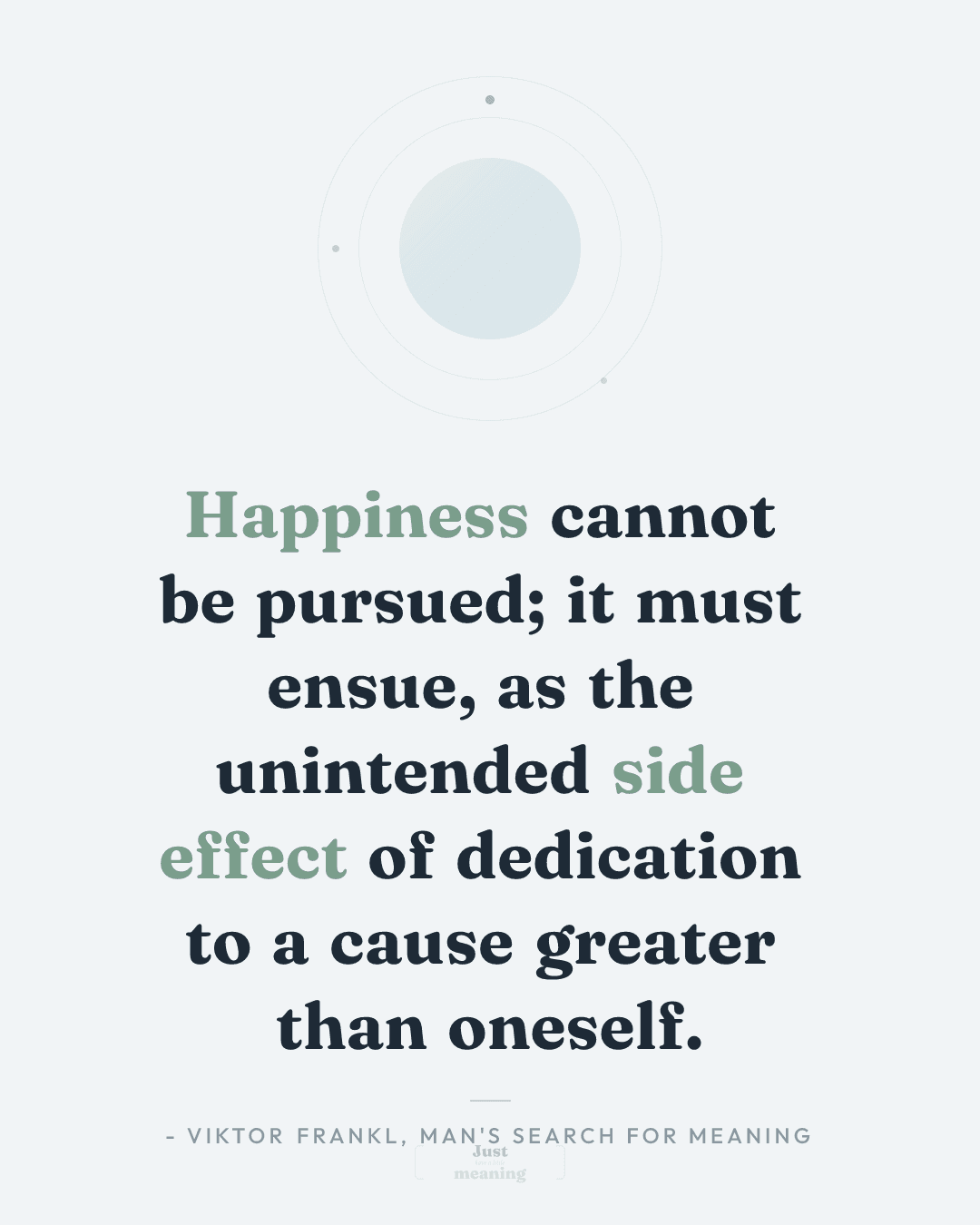
Viktor Frankl observed something that decades of research have since confirmed: people who have a sense of meaning cope better across every dimension. They handle adversity more effectively, are physically healthier, and, paradoxically, experience more of what we call happiness.
Frankl did not say happiness was bad or unnecessary. He said it cannot be a goal in itself. When you do something that matters to you, when you invest in relationships, work, creativity, learning, happiness appears on its own. Not because you went looking for it, but because you were doing things that naturally produce it.
Modern positive psychology arrived at the same conclusion from a different direction. Martin Seligman, who began by studying happiness, eventually shifted his focus to what he called flourishing. A state in which a person feels meaning, engagement, and strong relationships. In this model, happiness is not the goal but the byproduct of a meaningful life.
Engagement over pursuit
Mihaly Csikszentmihalyi spent decades studying the states of deepest satisfaction. He found that people feel their best not when resting or consuming pleasures, but when completely absorbed in a difficult yet meaningful task. He called this state flow.
In flow, you do not think about whether you are happy. You do not think about yourself at all. You are so engaged in what you are doing that the question of happiness becomes irrelevant. And that is precisely why people describe these moments, in retrospect, as some of the happiest of their lives.
It is the same paradox from a different angle. Happiness comes when you stop tracking it. Not when you ask "am I happy?" but when you ask "does what I am doing matter?"
Further reading
- •Man's Search for Meaning — Viktor Frankl
- •The Happiness Trap — Russ Harris
- •Flow: The Psychology of Optimal Experience — Mihaly Csikszentmihalyi
- •Flourish — Martin Seligman