


Talk to Think Clearly
Why thinking alone is not enough
It seems like all you need to sort something out is silence and focus. And that is partly true. But you can only think alone up to a certain point. After that, you start looping.
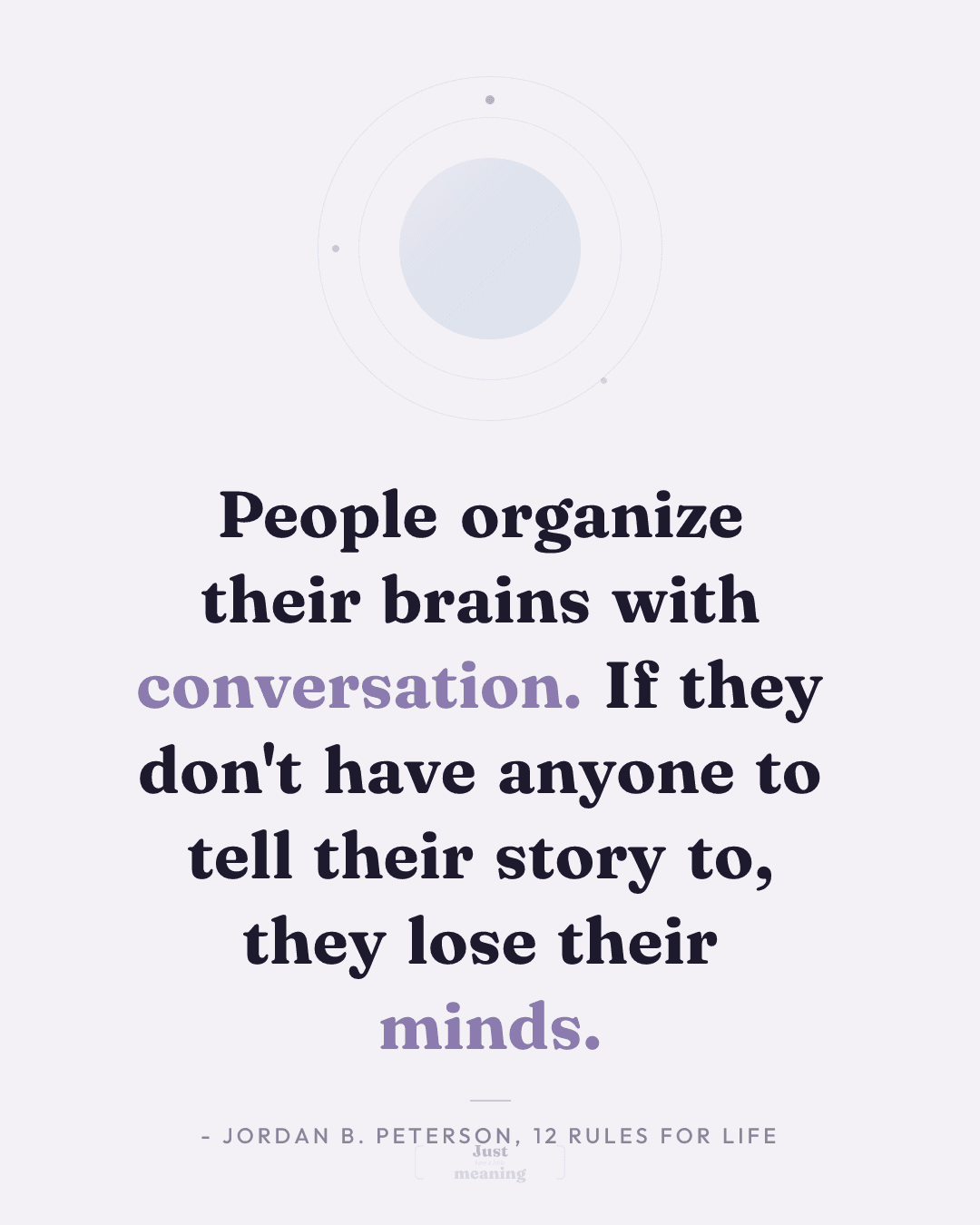
Jordan Peterson describes this clearly: people organize their brains through conversation. Not by thinking about thinking, but by speaking to someone who listens and can respond. When you put a thought into words, you have to simplify it, give it sequence, choose what matters. That process alone is a form of organizing.
But there is a second element. The other person reacts. They ask questions you would never ask yourself. They disagree where you would simply move on. They challenge assumptions that are invisible to you because you are sitting too deep inside them. Without that, your thinking becomes a closed loop. You enter with the same premises and exit with the same conclusions. Nothing changes.
The cost of isolation
John Cacioppo, a psychologist at the University of Chicago and a pioneer of social neuroscience, dedicated his career to studying loneliness. Not loneliness in the sense of being alone in a room, but in the sense of lacking meaningful contact with other people.
His findings are unambiguous. Chronic loneliness raises cortisol levels, impairs sleep, weakens the immune system, and degrades decision-making. But before those physical consequences set in, something subtler happens. Thinking loses its structure.
People who go for extended periods without someone to talk to honestly begin to understand their own emotions less clearly. Not because those emotions are complicated. Because without conversation, they never have the occasion to name them. And an emotion that has not been named remains as a general tension, irritability, unease without a clear cause.
Conversation as maintenance
This is not about therapy, although therapy works on a similar principle. It is about regular contact with someone you trust enough to say what you actually think.
It does not have to be a deep conversation about the meaning of life. Sometimes it is enough to tell someone what happened today and hear "that sounds rough" or "what did you do next?" These small exchanges organize more than hours of solitary reflection.
The mind needs an external reference point to calibrate itself. Without one, it starts to drift. Not suddenly, not dramatically, but gradually you lose contact with what is real and what is your interpretation.
Further reading
- •12 Rules for Life — Jordan B. Peterson
- •Loneliness: Human Nature and the Need for Social Connection — John Cacioppo, William Patrick
- •Social: Why Our Brains Are Wired to Connect — Matthew Lieberman