


The Ending Rewrites the Story
The peak-end rule
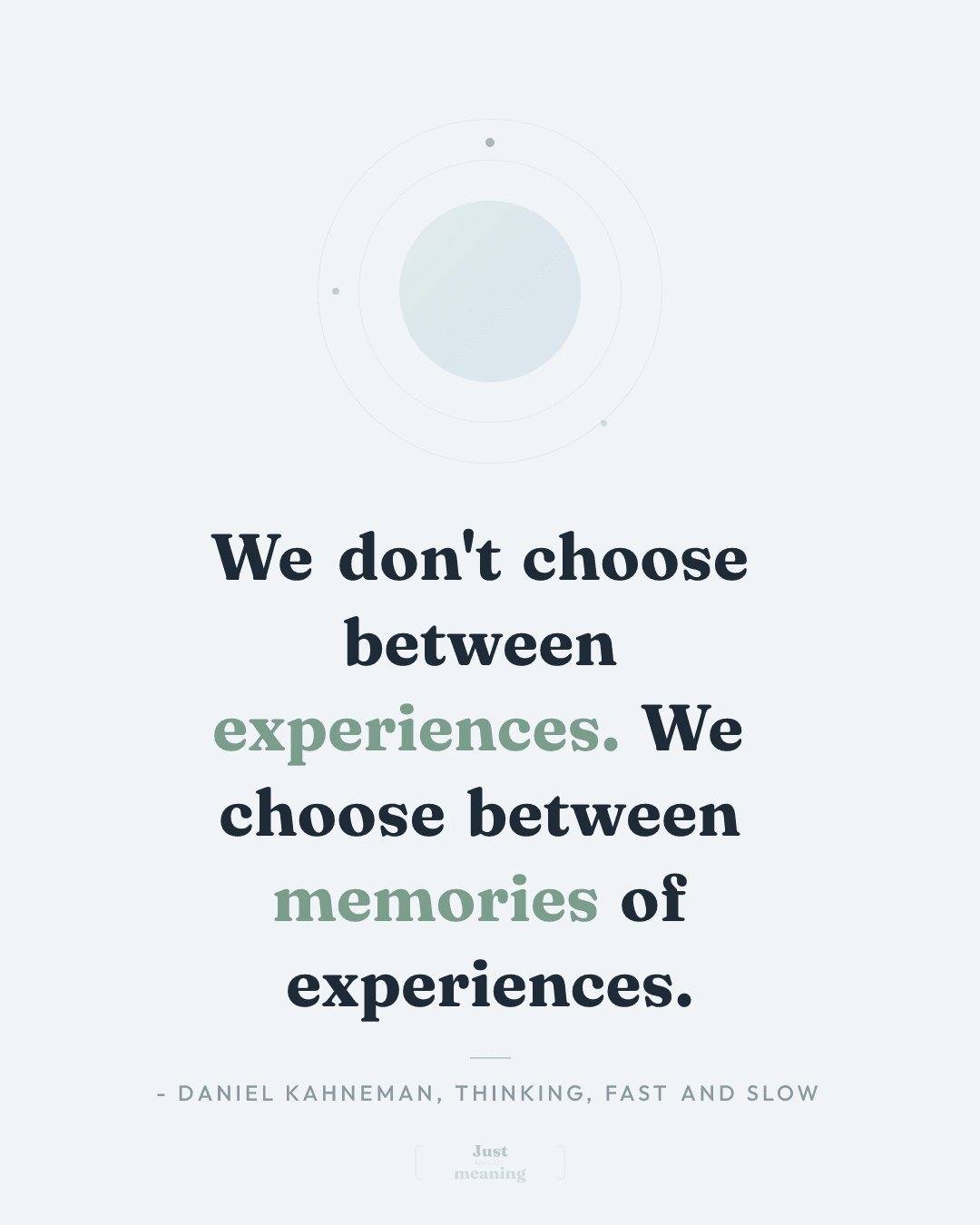
Daniel Kahneman, Nobel laureate in economics, discovered something that changes how we think about memory. In a series of experiments he showed that people do not evaluate experiences based on their full duration. They evaluate them based on two moments: the most intense point and the ending.
Kahneman called this the peak-end rule. In one classic experiment, participants held their hand in ice-cold water. One group for 60 seconds. Another for 90 seconds, but in the last 30 seconds the water was slightly warmer. Logically, the longer experience was worse because it contained more total suffering. But participants in the second group rated it as less unpleasant, because the ending was milder.
This is not a laboratory curiosity. The same mechanism operates in your memories of relationships, jobs, and major life events. You do not remember the full sum of experiences. You remember how they ended.
Redemption and contamination stories
Dan McAdams, a psychologist at Northwestern University, spent decades studying the way people tell their life story. He found that narratives fall into two main patterns.
The first is redemption stories. They start badly but end well. "I was in a dark place, but that experience taught me something that changed my life." People who tell their story this way have better mental health, a stronger sense of meaning, and greater resilience to future crises.
The second is contamination stories. They start well but end badly. "I had a wonderful childhood, and then everything fell apart." These people, even when their objective life circumstances are good, experience more depression and a greater sense of meaninglessness.
Crucially, McAdams is not saying some people have better lives and others worse. He is saying that the way you tell your story affects how you experience it. And the ending you give difficult chapters determines whether the memory weighs you down or strengthens you.
What this means in practice
Viktor Frankl survived three concentration camps. Objectively, that is one of the worst experiences a human being can endure. But Frankl gave that experience meaning. He wrote a book, created logotherapy, helped others. He did not change what happened. He changed the ending.
You do not need to go through something extreme for this mechanism to matter. It applies to everyday situations. A hard period at work that you finished with a new set of skills. A painful breakup after which you built better relationships. A failure that led you to something you would not have found otherwise.
This is not about pretending bad things were "actually good." It is about the fact that you have influence over the ending. And the ending rewrites the story.
Further reading
- •Thinking, Fast and Slow — Daniel Kahneman
- •The Redemptive Self — Dan P. McAdams
- •Man's Search for Meaning — Viktor Frankl