

You Favor Your Group, No Matter How It Was Formed
The experiment that changed social psychology
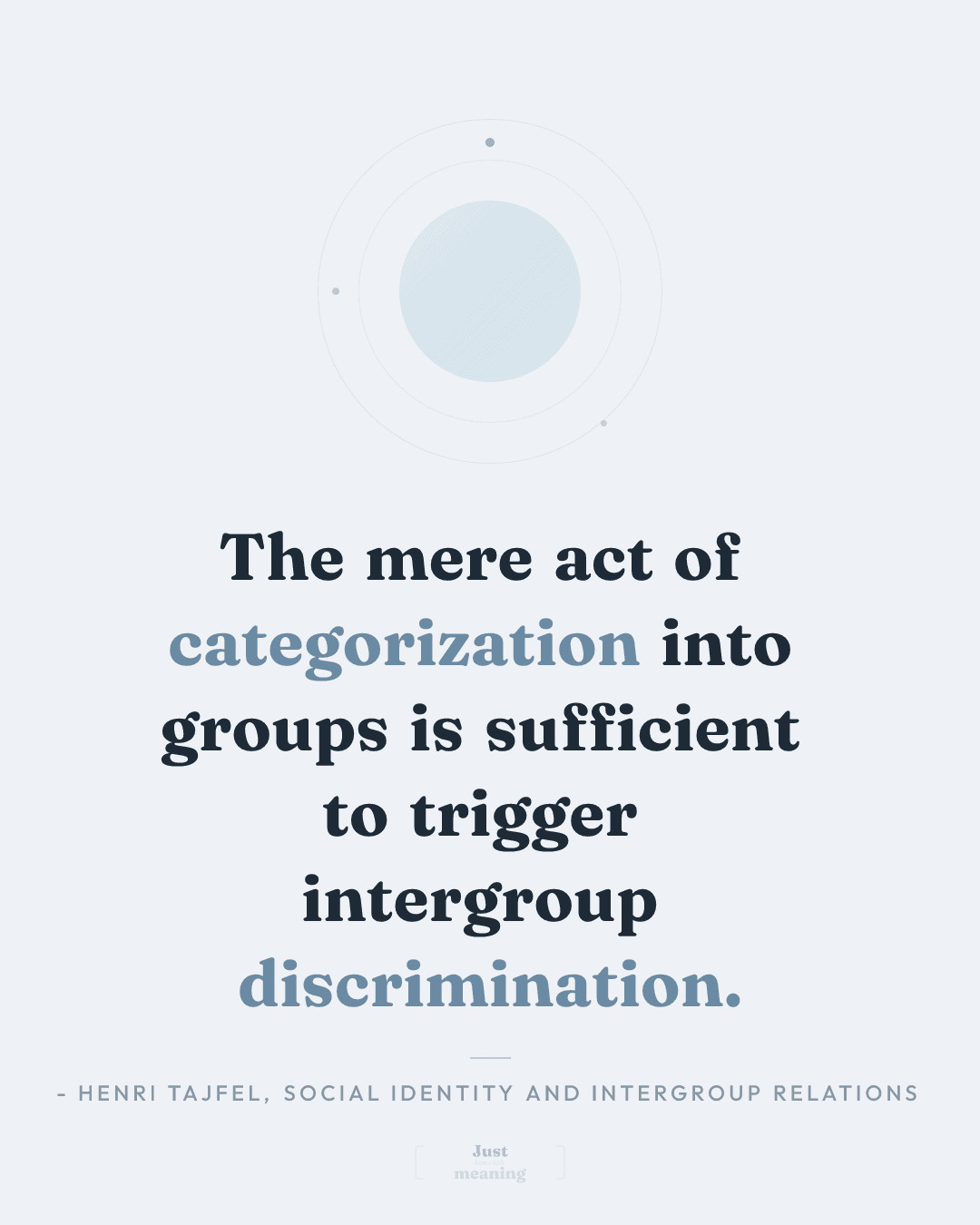
Henri Tajfel, a social psychologist who himself survived the Holocaust, wanted to understand the absolute minimum required to produce intergroup discrimination. His hypothesis was: perhaps the division into groups alone is enough, without any conflict, without competition for resources, without a history of mutual hostility.
He ran a series of experiments in which he divided participants into groups based on completely arbitrary criteria. Whether they preferred paintings by Klee or Kandinsky. Whether they overestimated or underestimated the number of dots on a screen. Later studies pushed this even further, dividing people by coin flip, and the effect still held. Participants did not know each other, had no reason for conflict, were not competing for anything.
The result was unambiguous. Even with such an absurd division, people immediately began favoring members of their own group. They awarded them more points, rated them higher, treated them more fairly. Tajfel called this the minimal group paradigm. It showed that the mere sense of "us" and "them" is enough to activate the preference mechanism.
Why your brain does this
Robert Sapolsky explains this mechanism from a neurobiological perspective. The division into in-group and out-group is not a learned attitude or a product of culture. It is a deeply embedded evolutionary mechanism. Your brain recognizes who is "one of us" and who is "other" in a fraction of a second, before you have time to think about it.
The amygdala, the structure responsible for threat detection, responds differently to faces of people outside the group than to faces of people within it. This is not racism or ill will. It is an automatic nervous system response that evolved in a time when a stranger genuinely could mean danger.
The problem is that this mechanism did not switch off when the world changed. It still divides people into "ours" and "others" based on arbitrary signals: the color of a shirt, an accent, political views, a department at work, a music preference. And it still makes you automatically treat one group better and the other worse.
What you can do about it
Jonathan Haidt, a moral psychologist, notes that this mechanism is so deep that it cannot be turned off. But it can be redirected.
The first step is noticing when it is happening. When you judge someone harshly, ask yourself: would I judge the same behavior the same way if this person were from "my" group? Often the answer is no. That question alone interrupts the automatic reaction.
The second step is expanding the definition of "us." Research shows that people can switch from hostility to sympathy remarkably quickly if they are included in a shared group. A common goal, a shared task, a common experience is enough. The mechanism that divides can also unite, provided the boundary between "us" and "them" shifts.
The point is not to pretend this mechanism does not exist. It exists and it is powerful. The point is to see it and consciously decide whether you allow it to direct your judgments.
Further reading
- •Social Identity and Intergroup Relations — Henri Tajfel
- •Behave — Robert Sapolsky
- •The Righteous Mind — Jonathan Haidt