


Your Brain Monitors Your Status
Why your brain watches the hierarchy
Jordan Peterson describes this mechanism starting from something surprising: lobsters. Many animals, from crustaceans to primates, have neurochemical systems that respond to social position. In lobsters, serotonin levels shift after wins and losses. In humans, the system is far more complex, involving serotonin, cortisol, and many other pathways, but the core principle holds: your brain tracks where you stand relative to others, and it responds physiologically. These systems share deep evolutionary roots going back over 350 million years.
In lobsters the system is straightforward. Lobsters that win confrontations have higher serotonin levels. They stand tall, take up more space, behave with more confidence. Those that lose have lower serotonin. They shrink, avoid confrontation, respond with anxiety.
In humans the mechanism is analogous, though more complex. Your brain does not monitor whether you won a physical fight. It monitors social signals: whether people listen when you speak. Whether they take your opinion seriously. Whether you are included or excluded. Whether someone shows you respect or dismissal. These signals affect serotonin levels, and serotonin affects mood, confidence, sleep quality, and stress resilience.
What the Whitehall studies found
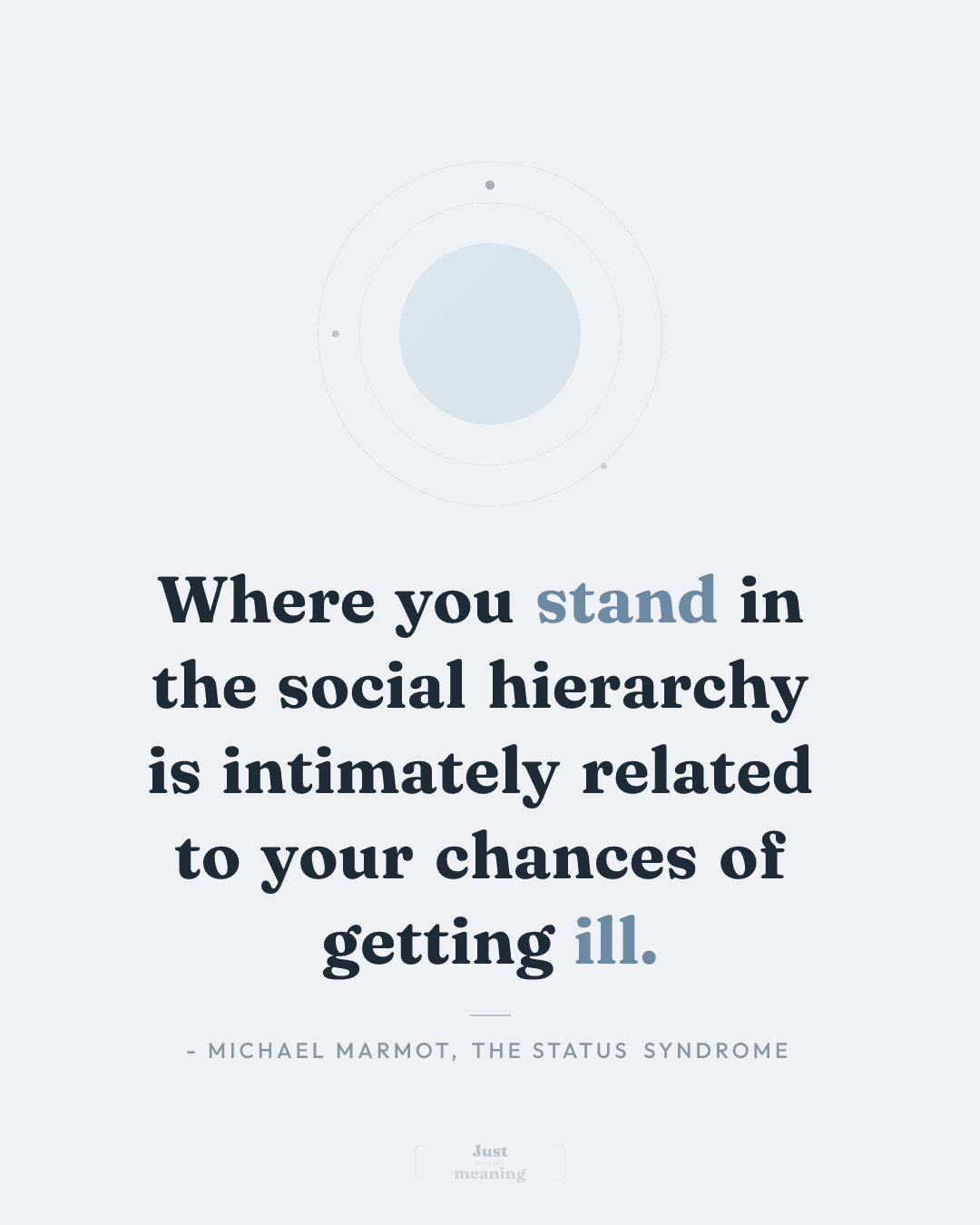
Michael Marmot, an epidemiologist at University College London, conducted one of the most important public health studies in history. He examined thousands of British civil servants, people working in the same institution, with access to the same healthcare, in the same country.
The result was unambiguous. The lower someone was in the bureaucratic hierarchy, the worse their health. More heart disease, more depression, more immune problems, shorter life expectancy. And crucially: it was not about money. Health differences existed even between people with similar incomes but at different levels of the hierarchy.
Marmot drew a conclusion from this that changed how we think about public health: it is not poverty itself that harms. It is the sense of low status, lack of control, being at the bottom. This chronic positional stress does things to the body that cannot be fixed with diet or exercise.
What you can do about it
This mechanism does not mean you have to climb to the top of a hierarchy to be healthy. It means something else: pay attention to how the people around you treat you.
Robert Sapolsky, a neurobiologist at Stanford who spent decades studying stress in primates, notes that what matters is not objective position in a hierarchy. What matters is perceived position. The feeling that you have control over your life. The feeling that you are treated fairly. The feeling that you belong to a group and that your presence matters.
If you are in an environment where you constantly feel dismissed, ignored, or talked down to, that is not "just" unpleasant. It affects your biochemistry, your sleep, your immune system, your mood. And it will not disappear from "positive thinking." Either you change how people treat you, or you change your environment.
Further reading
- •12 Rules for Life — Jordan B. Peterson
- •The Status Syndrome — Michael Marmot
- •Behave — Robert Sapolsky